

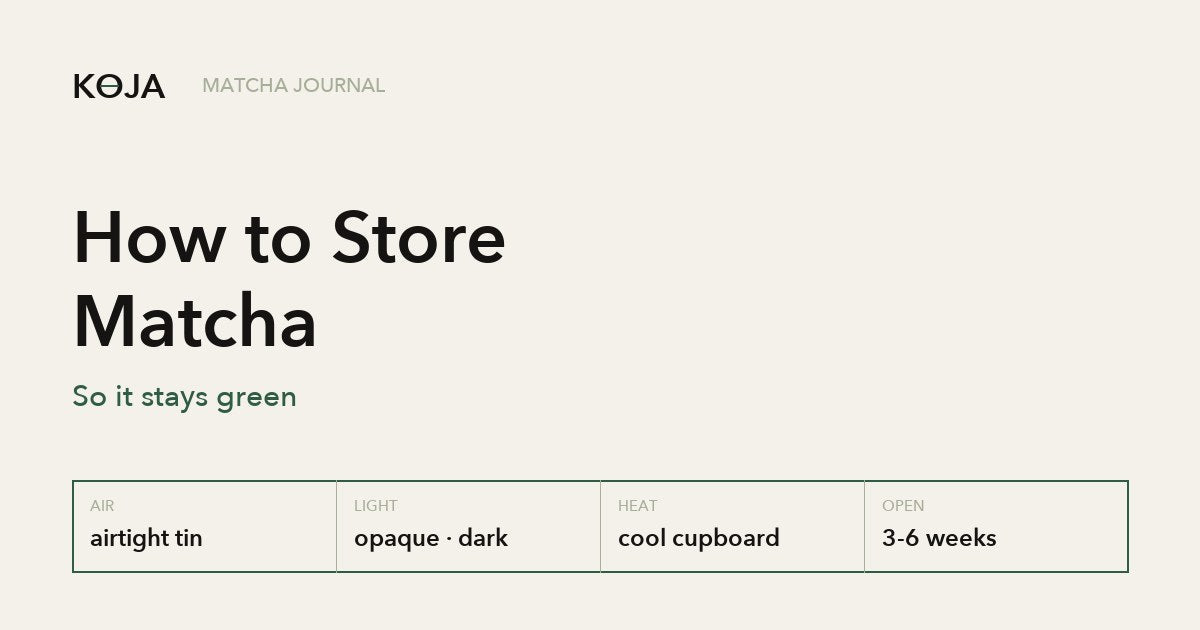
Short answer: Store matcha airtight, opaque, cool and dry, and finish an opened tin within a few weeks. Matcha has four enemies: oxygen, light, heat and moisture. The best-before date tells you almost nothing; the mill date and how long the tin has been open tell you everything.
Why does matcha age so fast?
Because it is a powder. Tencha, the unmilled leaf, stores well for months. The moment it is stone-milled, the surface area explodes and every particle is exposed to air. Oxidation pulls the vivid spring green toward olive, flattens the aroma and dulls the umami. This is not spoilage in the food-safety sense. Old matcha is safe. It is just a shadow of what you paid for.
That is why serious matcha is sold in small formats: a 30 g tin is 15 bowls at 2 g, sized to be finished while it still tastes like the first week. A 100 g bag of "value" matcha that sits open for four months is not a value.
The 4 storage rules
| Enemy | What it does | Your move |
|---|---|---|
| Oxygen | oxidizes color and aroma | airtight tin, press air out of pouches |
| Light | bleaches chlorophyll, green turns olive | opaque tin, never a glass jar on the counter |
| Heat | accelerates every aging process | cool cupboard, away from stove and kettle |
| Moisture | clumping, staleness, off notes | dry spoon only, close the tin right after use |
The everyday translation: keep matcha in its sealed opaque tin, in a cool dark cupboard, away from the kettle, and close it immediately after each bowl.
Should you store matcha in the fridge?
Unopened and long-term: the fridge or freezer is fine and common in the trade. Opened and in daily use: the cupboard is usually smarter. The problem is condensation. Every time a cold tin meets warm kitchen air, moisture lands on the powder, and moisture is enemy number four. If you do refrigerate an unopened tin, let it come to room temperature for a few hours before you break the seal.
The honest rule of thumb: buy formats you finish within weeks and the fridge question disappears.
How long does matcha last after opening?
At its best for about 3 to 6 weeks after opening, stored properly. It will not harm you after that, but the color and aroma tell the truth: when vivid green drifts toward olive and the smell goes from fresh and sweet-grassy to flat and hay-like, the window has closed. What a fresh bowl should look and taste like is covered in what good matcha should taste like.
The best-before date printed on most packaging is legally required and practically useless: it is usually set 12 to 18 months out and says nothing about the mill date or how long the tin has been open. This is why every KOJA tin prints its batch data instead: region, grade, harvest and lot, checkable on the verify page.
The structural answer: sealed small formats
The cleanest storage strategy is not a better cupboard. It is never having much open at once. That is the entire logic of the KOJA 90-day supply: 180 g split into 6 individually sealed 30 g pouches. Five stay factory-sealed while one is open, so bowl number 90 tastes like bowl number one. One box, one delivery, no stale tail end.
If you buy refills, copy the principle: decant a few weeks' worth into your empty tin, press the pouch flat to push the air out, seal it and store it cool and dark. The tin is the working vessel, the pouch is the vault.
FAQ
Can you freeze matcha?
Unopened, yes, and for long-term storage it works well. Always thaw the sealed container to room temperature before opening, or condensation will undo the benefit in one morning.
How do you know matcha has gone stale?
Look and smell before you taste: olive or yellowish color instead of vivid green, and a flat, hay-like smell instead of fresh sweetness. Stale matcha is safe to drink and fine for smoothies, but it will not deliver a proper bowl.
Does the best-before date matter for matcha?
Barely. It marks legal shelf life, not freshness. Mill date, harvest and time since opening matter far more, which is why KOJA prints batch data on every tin.
What is the best container for matcha?
An airtight, opaque tin, which is exactly what matcha ships in. Skip glass jars and clip-lock plastic boxes: light and air exposure defeat the purpose, whatever the label promises.

Share:
Yame Matcha: Japan's Quiet Premium Region, Explained
Matcha-Knappheit 2026: Warum Matcha so teuer geworden ist