

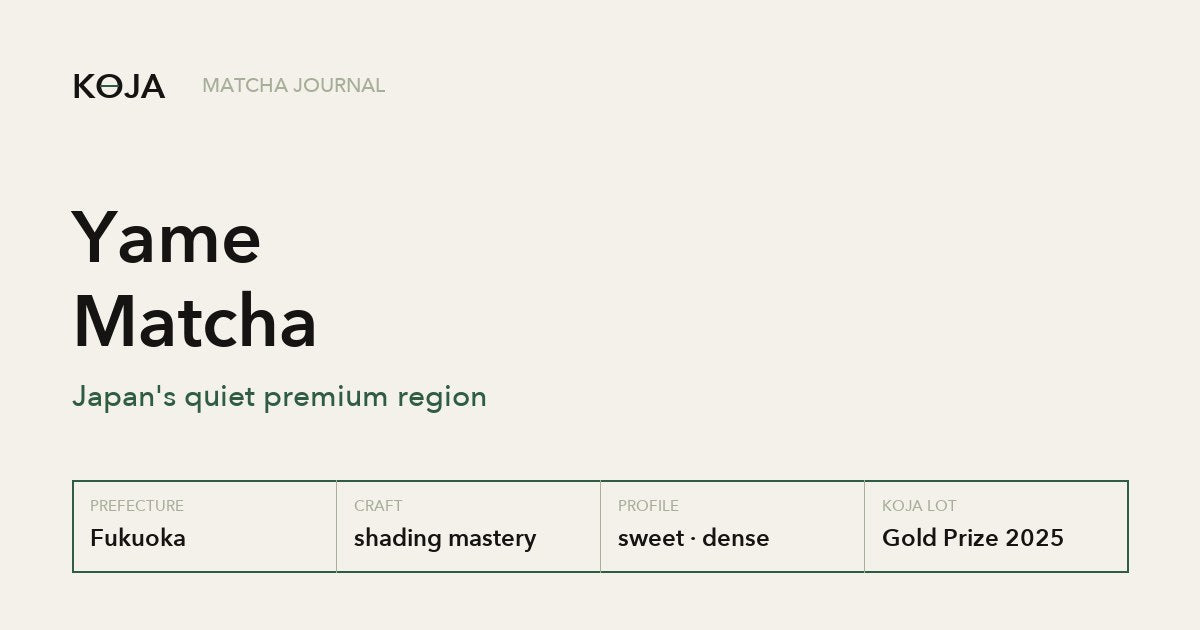
Short answer: Yame is a small tea region in Fukuoka prefecture, southern Japan, and pound for pound one of the country's most decorated growing areas. It built its name on gyokuro, the most heavily shaded Japanese leaf tea, and that shading mastery is exactly what makes Yame matcha special: deep sweetness, thick umami and almost no bite, in harvests too small for supermarket shelves.
Where is Yame and why do tea people whisper about it?
Yame sits inland in Fukuoka prefecture on Kyushu, a few hours north of Kagoshima. It is tiny compared with Japan's volume regions, but it holds a share of national tea awards far above its size, built on one specialty: shading. Yame produces a large part of Japan's top-rated gyokuro, the leaf tea that spends its final weeks before harvest under near-total shade.
That matters for matcha because shading is the heart of the craft. Cover the plant, and it responds by concentrating amino acids like L-theanine in the young leaf: more sweetness, more umami, less astringency. A region that has spent generations perfecting shade culture for gyokuro brings the same hands and the same instincts to tencha, the leaf that becomes matcha.
What does Yame matcha taste like?
Rounder and sweeter than most of what you have tried. The typical Yame profile leads with a natural, almost syrupy sweetness, carries dense umami underneath and finishes soft, with barely any of the sharp edge that untrained palates read as "green tea bitterness". Compared with the two regions most drinkers know:
| Region | Character | Best known for |
|---|---|---|
| Kagoshima | deep umami, full body | modern gardens, early harvests, scale |
| Uji | bright, clean, elegant | the historic matcha heartland |
| Yame | sweet, dense, soft finish | shading mastery, awarded gyokuro and tencha |
If Kagoshima is depth and Uji is clarity, Yame is roundness. It is the bowl you slow down for.
Why is Yame matcha rare and expensive?
Small region, labor-heavy method, tiny yields. Heavy shading stresses the plants and cuts volume, hand work drives cost, and most of the limited output stays inside Japan, where Yame's name needs no explanation. The 2025/26 tencha shortage tightened this further: when demand outruns harvests, the smallest premium regions sell out first.
That scarcity is why Yame matcha usually appears as limited lots rather than permanent catalog items, and why a serious Yame tin costs more per gram than an everyday blend. Judged per bowl the gap is smaller than it looks: at 2 g per bowl, a 30 g tin is 15 deliberate bowls, not a daily commodity.
KOJA Yame Imperial: our reserve lot
KOJA Yame Imperial is Yame no Mukashi from Yame, the highest grade in our range and the only KOJA matcha with an award attached: Gold Prize at the Japanese Tea Selection Paris 2025. It is naturally sweet, carries no bitterness at the right temperature and comes as a limited 30 g tin for 59 EUR. No refill, no subscription, one lot at a time. When it is gone, it is gone until the next lot clears our bar.
Like every KOJA tin it ships with its batch data printed on the tin: region, grade, harvest and lot, checkable on the verify page. With a matcha at this level, that paper trail is the difference between a story and a claim.
How to prepare a reserve-grade bowl
Treat it like the straight bowl it was made for: sift 2 g, add about 70 ml of water at 70 to 80 C and whisk in a light W motion until a fine foam stands. Two honest rules: never boiling water, and no milk. Milk buries exactly the sweetness and depth you paid for. Keep lattes for a blend built for milk and give Yame the water it deserves. The full method lives in the how to make matcha guide.
Want to taste before committing to the tin? The Yame Imperial sample is 10 g for 9.90 EUR, five bowls of proof. The rest of the limited shelf lives in the Reserve collection, and the region comparison continues in Kagoshima vs Uji.
FAQ
Is Yame matcha better than Uji matcha?
Different, not better. Uji runs bright and elegant, Yame runs sweet and dense. Both regions produce exceptional matcha. Yame's edge is its shading tradition from gyokuro culture, which shows as roundness in the bowl.
Why does Yame matcha cost more?
Small region, heavy shading, low yields and most output staying in Japan. Scarcity is structural, not marketing. Per 2 g bowl the premium is modest for what lands in the cup.
Can I make a latte with Yame matcha?
You can, but you should not. Milk covers the sweetness and depth that make Yame worth its price. For lattes use a blend with body and keep Yame for the straight bowl.
What does Imperial mean at KOJA?
Our label for the top shelf of the range. Like "ceremonial", it is not a protected term, so we back it with what is checkable: origin Yame, the Paris 2025 Gold Prize and batch data on every tin.
Share:
Hojicha vs Matcha: Caffeine, Taste and When to Drink Which
How to Store Matcha So It Stays Green