

If your first matcha tasted like a mowed lawn, you did not taste matcha. You tasted bad matcha, probably prepared with boiling water. This mix-up costs the category more customers than any price tag, because nobody orders a second bowl of lawn. Ask the internet what does matcha taste like and you get "grassy", which is half wrong and fully useless. There is a precise answer, it has five components and once you know them you can judge any tin in one sip, no sommelier vocabulary required.
What does matcha taste like when it is good?
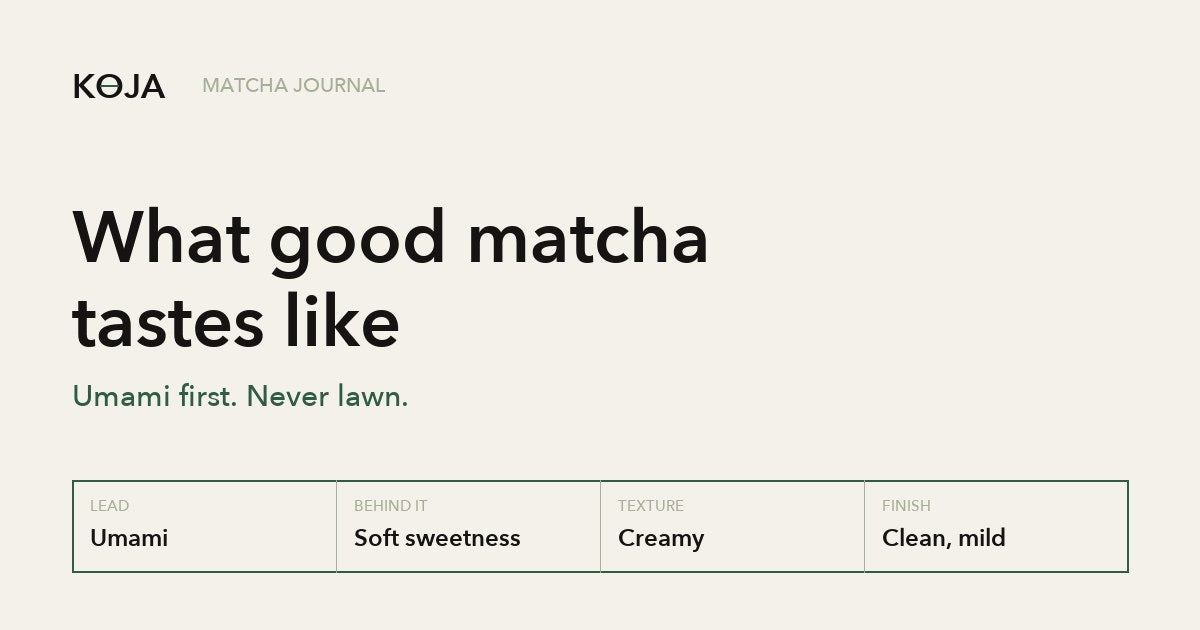
Good matcha leads with umami, the round savory depth you know from broth or nori. Behind it sits a gentle natural sweetness, then a creamy, almost silky texture when whisked. Fresh green notes, think sweet peas or young spinach, sit on top. The finish has a mild, clean astringency that resets your palate. What it never has: sharp bitterness, hay, dust or a chalky mouthfeel.
What are the five taste components?
- Umami. The signature. Shaded tea leaves build amino acids, including L-theanine, and those read on your tongue as savory depth. No umami, no serious matcha.
- Sweetness. Not sugar-sweet. A soft, vegetal sweetness that first-harvest leaves carry naturally and later harvests lose.
- Texture. Whisked well, good matcha is creamy with a fine standing foam. Thin and watery means coarse grind or low dose, gritty means bad milling.
- Green top notes. Fresh, alive, closer to sweet pea and young herbs than to grass clippings. A faint nori note is normal and correct.
- Clean astringency. A slight dryness at the finish that makes you want the next sip. Astringency is structure. Bitterness is a defect or a preparation error.

Good matcha vs bad matcha: the taste table
| Component | Good matcha | Bad matcha |
|---|---|---|
| First impression | Round umami, savory depth | Flat, dusty, sour or sharp |
| Sweetness | Soft and vegetal, no sugar needed | Absent, needs sweetener to be drinkable |
| Texture | Creamy, fine foam | Thin, gritty or chalky |
| Green notes | Sweet pea, young herbs, faint nori | Hay, straw, mowed lawn |
| Finish | Clean, mild astringency | Lingering harsh bitterness |
Where does the umami come from?
From shade. Three to four weeks before harvest, tencha fields are covered so the plants slow photosynthesis and accumulate amino acids instead of converting them into catechins. Amino acids taste like umami and sweetness. Catechins taste bitter and astringent. That single farming decision, plus how early the leaves are picked, decides more of the flavor than anything printed on the front of the tin. It is also why first harvest matters so much: those leaves spent the whole winter storing what you taste, a point we break down in how to choose matcha.
Can preparation ruin good matcha?
Absolutely, and it usually does. Boiling water scorches amino acids and pushes bitterness forward, unsifted clumps burst bitter on your tongue and doubling the dose doubles the harshness. Use 2 g, sifted, with water at 70-80 °C. If your bowl still tastes harsh after that, the powder is the problem, and why matcha tastes bitter walks through the diagnosis in order.
How does milk change the taste?
Milk mutes the top notes, keeps the body and softens the finish. Good matcha becomes a creamy, deep latte. Delicate matcha becomes an expensive beige drink, and harsh matcha becomes a slightly politer harsh drink. If most of your matcha meets milk, choose for body, not for subtlety. The full logic is in the best matcha for lattes.
How fast does the taste fade after opening?
Faster than most tins admit. Once opened, matcha meets oxygen, light and humidity, and the fresh green top notes are the first to go. Within six to eight weeks an opened tin drifts toward flatness even with perfect storage. Two practical conclusions: buy 30 g formats you finish within a month instead of a large tin that ages on your counter, and keep it sealed, cool and dark between bowls. Sealed portions solve this structurally, which is the quiet logic behind the Daily 90-day box: six 30 g bags, one open at a time, five staying factory-fresh.
How do you taste like a buyer?
Do a two-bowl comparison. Whisk 2 g of your current matcha and 2 g of a first-harvest single origin side by side, same water, same temperature. Taste for the five components in order: umami, sweetness, texture, green notes, finish. The difference is not subtle, and after one comparison you will never need a grade word again. Our reference bowl for this test is the Kagoshima Ceremonial, a single estate first harvest with garden, region, harvest and mill date printed on the tin, 39 € for 30 g. The rest of the range is in the matcha collection.
FAQ
Is matcha supposed to taste bitter?
No. A mild astringent finish is normal and pleasant. Sharp, lingering bitterness means late-harvest powder, old stock or water that was too hot. Good matcha prepared at 70-80 °C does not need sugar to be drinkable.
Why does my matcha taste like seaweed?
A faint nori note is a sign of shaded, amino-acid-rich leaves and belongs to the profile. If seaweed dominates everything else, the powder is usually old or was stored badly.
Does good matcha need sweetener?
Straight with water, no. First-harvest matcha carries its own vegetal sweetness. In milk drinks sweetener is taste, not necessity. If a matcha is undrinkable without sugar, it failed the quality test.
What does ceremonial matcha taste like compared to culinary?
Typical ceremonial lots lead with umami and sweetness and finish clean. Culinary lots are stronger, more astringent and built to cut through milk, sugar or butter. The words are unregulated, so trust your tongue and the label facts over the grade name.
Share:
Iced Matcha Latte Recipe: 3 Minutes, No Shaker
Matcha Latte Rezept: cremig in 4 Schritten, ohne Klümpchen