

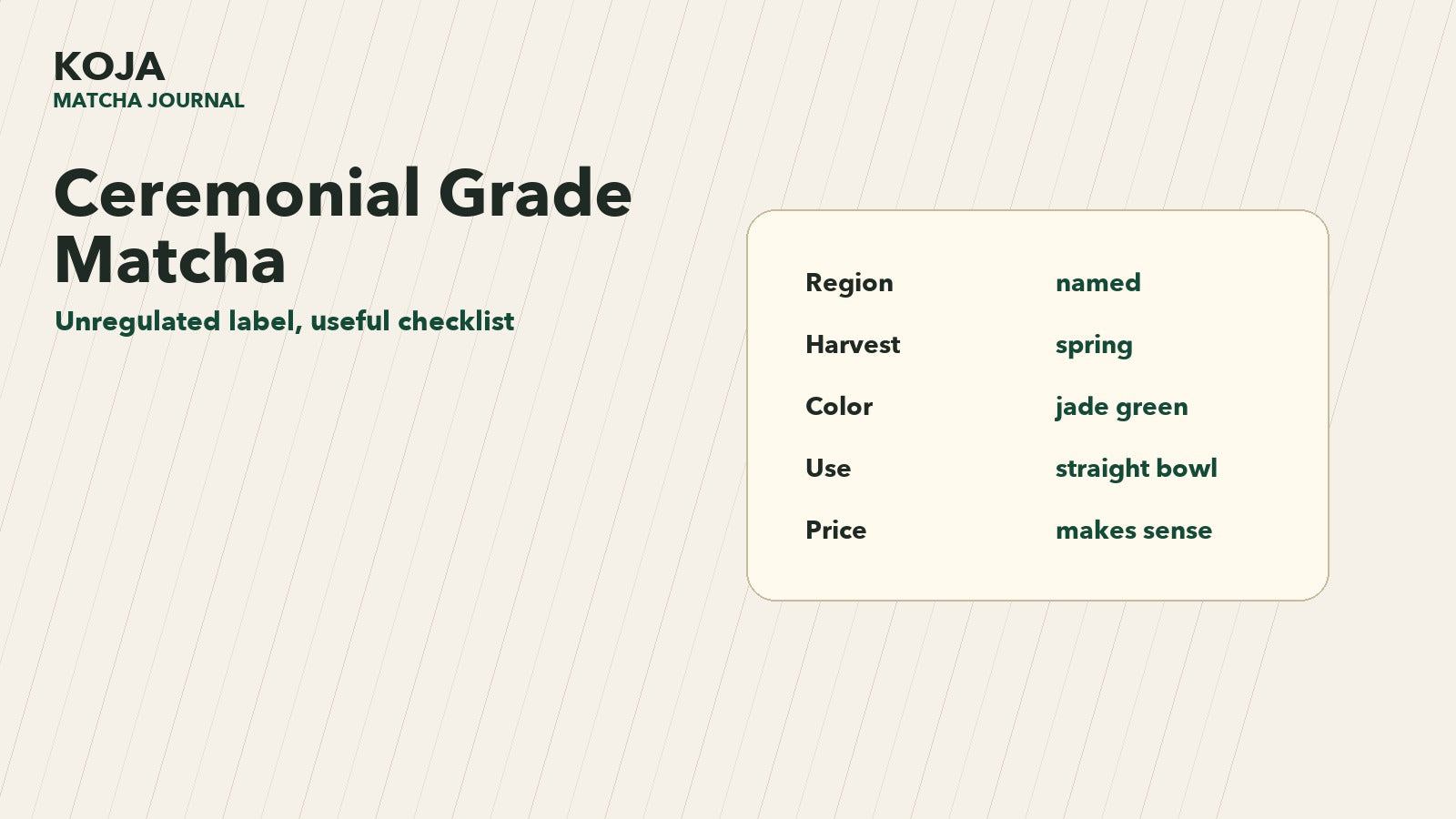
Short answer: Ceremonial grade matcha is not a legally protected grade. Used honestly, it means matcha good enough for a straight bowl with water. Used loosely, it can be a label on powder that should have been sold as daily, latte or culinary grade.

What does ceremonial grade matcha actually mean?
Ceremonial grade matcha should mean a drinking-grade powder made for a straight bowl. It should look saturated green, whisk cleanly, taste balanced and not need milk to hide bitterness.
The problem is that ceremonial is not a protected legal category. There is no global certifying body checking every bag. That makes the word useful only when the rest of the facts support it.
How can you check ceremonial grade before buying?
Check concrete signals before trusting the label: region, grade explanation, color, serving size and realistic price per bowl. If those are missing, ceremonial is just packaging copy.
- Region: Kagoshima, Uji and Yame are meaningful. "Japan" alone is thinner.
- Use case: ceremonial should work with water, not only milk.
- Color: saturated green is a better sign than dull olive.
- Dose: 2 g per bowl is the honest baseline.
- Price: real drinking-grade matcha cannot be both very cheap and very good.
When does the ceremonial label lie?
The ceremonial label lies when it is used to make low-grade powder sound rare. The easiest warning signs are weak serving sizes, no named region, old-looking color and a price that only works if the leaf material was cheap.
Another warning sign is a brand that never tells you what the product is for. Straight bowls, daily use and lattes are different jobs. One powder can be versatile, but no powder is best at everything.
What is the difference between ceremonial, daily and latte matcha?
Ceremonial matcha is for straight bowls. Daily matcha is for repeat use where balance and value matter. Latte matcha is built to hold up under milk.
| Grade route | Best use | What matters most |
|---|---|---|
| Ceremonial | Straight bowl | Color, umami, low bitterness |
| Daily premium blend | Routine bowl or latte | Repeatability and cost per bowl |
| Latte grade | Milk drinks | Body, color and intensity |
That is why KOJA separates ceremonial matcha, daily matcha and matcha for lattes.
Why is KOJA Daily not called ceremonial?
KOJA Daily is not called ceremonial because it is a daily premium blend, not a single-origin ceremonial product. We could stretch the label. We do not, because the whole brand promise is that labels should reduce confusion, not exploit it.
Daily is built for the everyday whisk and for lattes. Kagoshima Ceremonial is built for straight bowls. Both can be good products. They should not pretend to be the same product.
Which KOJA ceremonial matcha should you choose?
Choose by use case. If you want a straight bowl, start with ceremonial matcha. If you want a structured daily habit, compare the 90-day boxes. If you are not sure which profile fits, the sample set gives you all 5 sorts as 10 g samples first.
Run the same test every time: 2 g powder, 60-70 ml water at 70-80 C and no milk for the first sip. If the powder needs milk to taste acceptable, the ceremonial claim is doing too much work.
Buy the use case, not the adjective
If you drink matcha straight, start with KOJA ceremonial matcha. If your real drink is a latte, use matcha for lattes and spend the savings on better milk.
FAQ
Is ceremonial grade matcha regulated?
No. Ceremonial grade is not a protected legal grade. Use it as a clue, then check region, dose, color and price.
What should ceremonial matcha be used for?
Use ceremonial matcha for straight bowls with water. If you mainly add milk, Daily or latte-grade matcha usually makes more sense.
Why is KOJA Daily not called ceremonial?
Because KOJA Daily is built as a daily premium blend. We do not stretch ceremonial language just because the market allows it.
Keep reading: Kagoshima vs Uji · How to Choose Matcha
Share:
Why Does Matcha Taste Bitter? 3 Mistakes and 1 Honest Truth
How Much Does a Matcha Habit Actually Cost?