

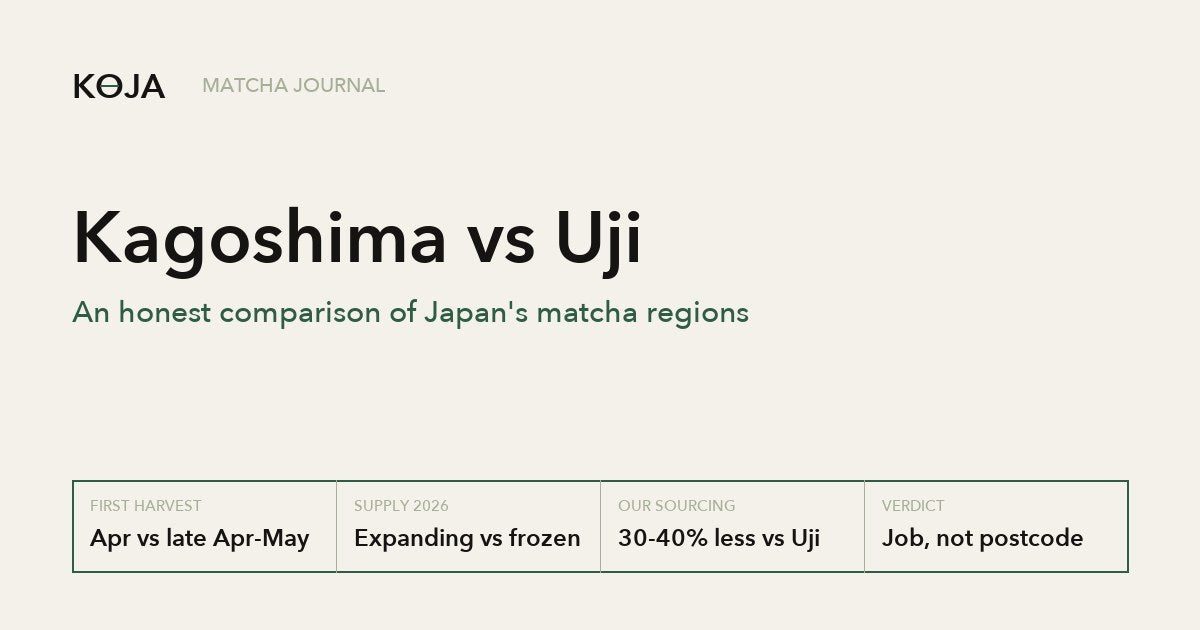
Say "good matcha" and most people reflexively say Uji. That reflex is 800 years old and it is also the reason Uji tencha auction lots peaked at 43,330 yen per kilo in 2025, roughly 3.6 times the year before. Meanwhile Kagoshima matcha, grown in one of Japan's largest organic tea regions, still gets treated like the discount shelf. Both reputations are out of date. Here is an honest comparison of Japan's two most talked about matcha regions: what each one is genuinely good at, where the folklore ends and which one belongs in your bowl.
What is the quick answer on Kagoshima vs Uji matcha?
Uji is the historic benchmark: small terraced fields near Kyoto, centuries of tencha craft and the highest prestige per gram. Kagoshima is the modern powerhouse: large volcanic-soil farms in Japan's warm south, early first harvests, strong cultivar variety and a large share of the country's certified organic tea. Quality overlap is bigger than the price gap suggests. A well-made first-harvest Kagoshima matcha routinely outperforms a mid-tier Uji tin that trades on its postcode.
What makes Uji matcha special?
Uji, south of Kyoto, is where shaded tea cultivation and tencha processing were refined over centuries. The region's strengths are real.
- Craft density. Generations of growers, refiners and stone-mill operators in one small area. The top end of Uji is still the top end of matcha, full stop.
- Celebrated cultivars. Samidori, Gokou and Asahi were bred for shaded sweetness and umami depth.
- Prestige. Tea ceremony schools and heritage houses anchor demand for the finest lots.
The catch is supply. Uji is small, its fields cannot scale and since the 2025 demand shock its heritage houses have frozen new wholesale accounts and put existing buyers on allocation. Scarcity now sets the price as much as quality does. We unpacked that mechanism in the matcha shortage explained.
What makes Kagoshima matcha special?
Kagoshima sits at the southern tip of Kyushu, on volcanic soil with a warm maritime climate. For matcha buyers that translates into five practical advantages.
- The earliest first harvest in Japan. Warm springs mean Kagoshima picks its first flush weeks before Kyoto. First harvest is the single strongest quality predictor on any label.
- Modern, mechanized farms. Larger flat fields allow precise shading and consistent processing at scale. Consistency per batch is easier to hold than in fragmented terraced plots.
- Cultivar range. Yutakamidori, Okumidori and Saemidori give blenders real material to work with. Okumidori in particular carries the saturated jade color that quality buyers look for.
- Organic strength. Kagoshima is one of Japan's largest sources of certified organic tea, which matters if clean cultivation is on your checklist.
- Price sanity. In our own sourcing, comparable first-harvest lots from Kagoshima cost us 30 to 40 percent less than their Uji equivalents, because nobody charges us for the postcode.

Kagoshima vs Uji: the direct comparison
| Uji (Kyoto) | Kagoshima (Kyushu) | |
|---|---|---|
| Claim to fame | Historic heart of tencha, top-end prestige | Volume, organic share, modern farms |
| First harvest | Late April to May | Early to mid April, earliest in Japan |
| Typical profile | Layered umami, fine sweetness, delicate top notes | Deep green, round umami, fuller body |
| Field structure | Small, terraced, hard to scale | Large, flat, mechanized |
| Supply since 2025 | Allocation, frozen new accounts | Expanding tencha production |
| Price for first-harvest quality | Premium plus scarcity premium | Well below comparable Uji lots |
| Best for | Collectors, ceremony, top-end straight bowls | Daily bowls, lattes, honest price per gram |
Does region decide quality?
No. Region shifts the odds, it does not settle the bet. The quality drivers that actually show up in your bowl are harvest timing, shading discipline, cultivar, grinding and freshness. All five exist on both sides of this comparison. A late-harvest Uji culinary powder loses to a first-harvest Kagoshima ceremonial every time, whatever the label implies. If you want the full buying framework, use how to choose matcha and the matcha grades page.
Why does KOJA source from Kagoshima?
We buy Kagoshima first harvest directly because it is where quality, supply security and price still line up. Our Kagoshima Ceremonial is a single estate matcha, 39 € for a 30 g tin, with garden, region, harvest and mill date printed on the tin. The same sourcing logic feeds our blends. No folklore surcharge, batch facts instead. You can see every current lot in the Kagoshima collection.
To be clear, this is not an anti-Uji position. Top Uji lots are extraordinary. But at current allocation prices they are a collector's buy, not a daily habit, and paying Uji prices for mid-tier Uji is the worst deal in matcha right now.
Which region should you buy?
- You drink matcha daily, often with milk: Kagoshima or a Kagoshima-based blend. The fuller body survives milk and the price per bowl stays rational.
- You drink straight bowls and want depth: first-harvest Kagoshima ceremonial covers 90 percent of what most palates extract from top Uji, at a fraction of the price.
- You collect or host ceremony: a top Uji lot from a heritage house is worth experiencing at least once. Buy it for water, never for a latte.
Want the honest test?
Whisk a 2 g bowl of first-harvest Kagoshima matcha next to whatever you currently rate, same water, 70-80 °C. If the region label was doing the heavy lifting, you will taste it immediately. The tin to run that test with is Kagoshima Ceremonial, and the rest of the lots live in the Kagoshima collection.
FAQ
Is Uji matcha better than Kagoshima matcha?
At the very top end, Uji still leads. Below that, first-harvest Kagoshima matcha regularly matches or beats mid-tier Uji at a clearly lower price. Harvest and freshness predict quality better than region.
Why is Uji matcha so expensive right now?
Demand outran a supply that cannot scale. Uji tencha auction lots peaked at 43,330 yen per kilo in 2025, about 3.6 times the prior year, and heritage houses put buyers on allocation. Scarcity is priced in.
Is Kagoshima matcha good for lattes?
Yes. Kagoshima's fuller body and deep green color hold up under milk better than delicate top-end lots. That is exactly the job of a latte matcha.
What should a Kagoshima matcha label show?
The same facts as any serious matcha: first harvest, a named garden or estate, vivid jade color and a recent mill date. If the label hides those, the region name will not save it.
Share:
Iced Matcha Latte Recipe: 3 Minutes, No Shaker
The Best Matcha for Lattes: What Survives Milk