

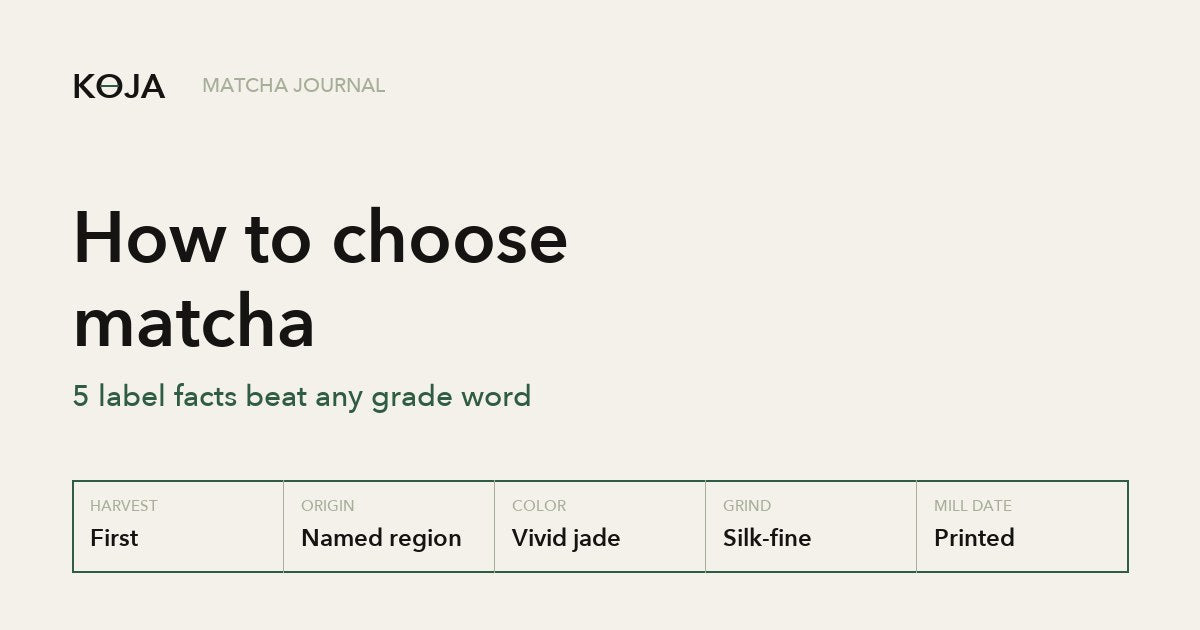
Pick up any matcha tin and you will read some version of "Premium Organic Ceremonial Grade Matcha". That sentence can be printed on a 9 € supermarket pouch and on a 90 € heritage lot, because not one word in it is regulated. So how do you pick well when the front of the label is marketing? You read the back. Knowing how to choose matcha comes down to five facts that predict what lands in your bowl. All five are checkable before you pay and any seller who hides them is answering your question anyway.
What is the quick answer on how to choose matcha?
Ignore the grade word and check five facts: a stated first harvest, a named origin region, vivid jade color, a silk-fine stone grind and a printed mill date. Then match the matcha to its job: single origin for straight bowls, a robust blend for milk. Price per gram only makes sense inside a use case, never across all matcha.
Why is the grade word the weakest signal?
No regulator in Japan or the EU defines ceremonial, premium or barista grade. Any importer can print any of them, and during the current supply squeeze many do. That does not make every ceremonial label a lie, it makes the word alone worthless as evidence. We unpacked this in what ceremonial grade actually means and on the matcha grades page. Treat the grade word as a claim, then look for the facts that would back it up.

Which five label facts actually matter?
- 1. Harvest. First harvest (spring) leaves carry the sweetness and umami that define good matcha. Later harvests carry more bitterness. If the label does not say first harvest, assume it is not.
- 2. Origin. A named region such as Kagoshima, Uji, Yame or Nishio, ideally a named garden. "Product of Japan" narrows it down to an entire country. Regions differ in style, which we compared in Kagoshima vs Uji.
- 3. Color. Vivid jade green means young shaded leaves and careful handling. Olive, khaki or yellow-green means old powder, late harvest or bad storage. Color is the one fact you can verify with your own eyes.
- 4. Grind. Stone-ground matcha is silk-fine and disappears under the whisk. Coarse, gritty powder sinks and streaks. Machine-milled bulk powder saves the seller money and costs you texture.
- 5. Mill date. Matcha fades within months of grinding, faster once opened. A printed mill or batch date proves the seller has fresh stock and nothing to hide. During a shortage this is the hardest fact to fake, as we noted in the matcha shortage explained.
What are the red flags?
| Red flag | What it usually means |
|---|---|
| No harvest stated | Later harvest or mixed lots |
| "Product of Japan" with no region | Traded bulk powder of unclear origin |
| Olive or yellowish color | Old, late harvest or badly stored |
| No mill or batch date | Warehouse stock, age unknown |
| Grade word does all the talking | Marketing where facts should be |
Does price per gram tell you anything?
Only inside a use case. A milk-first blend can be honest at 0.14 € per gram because it is built for volume and intensity, while a single estate ceremonial is honest at 1.30 € per gram because first-harvest single lots are genuinely scarce. Comparing those two numbers tells you nothing. Comparing two ceremonial tins where one costs a third of the other and names no harvest tells you everything. The per-bowl math is in what a matcha habit actually costs.
How do you match matcha to your use case?
| You mostly drink | Choose | At KOJA |
|---|---|---|
| Straight bowls with water | First-harvest single origin | Kagoshima Ceremonial, 39 € / 30 g tin |
| A daily bowl, sometimes milk | Robust first-harvest blend | KOJA Daily, 29 € / 30 g tin |
| Lattes, most days | A blend built for milk | Matcha for Lattes collection |
| A fixed routine, no re-ordering | Sealed supply format | Daily 90-day box, 89 €, 0.99 € per bowl |
If milk is your main format, the deeper guide is the best matcha for lattes.
What does KOJA print on the tin?
Garden, region, harvest and mill date, on every tin. Not because it sounds nice, but because those are the four facts we would demand as buyers. If every seller printed them, choosing matcha would take thirty seconds. Until then, this checklist is your shortcut.
Want the honest test?
Take the tin you own now and score it against the five facts. Zero to two named facts, you were buying the grade word. Then pick your next tin by use case in the matcha collection and compare the difference bowl for bowl.
FAQ
What is the best matcha for beginners?
A first-harvest blend rather than the most expensive single origin. It is forgiving in preparation, works with water and milk and teaches you what good matcha tastes like before you spend collector money.
Is expensive matcha always better?
No. Price reliably reflects scarcity and prestige, not always quality in your bowl. A 39 € first-harvest single origin can outperform a 60 € tin that trades on region alone. Check harvest, color and mill date before price.
What color should good matcha be?
Vivid jade to deep spring green. Olive, khaki or yellowish powder signals age, late harvest or poor storage, and no preparation method will bring the color back.
Does organic certification matter for matcha?
It verifies cultivation practices, which is worth something, but it says nothing about harvest, freshness or grind. Treat organic as one fact among five, not as a quality grade.
Share:
Iced Matcha Latte Recipe: 3 Minutes, No Shaker
The Best Matcha for Lattes: What Survives Milk