

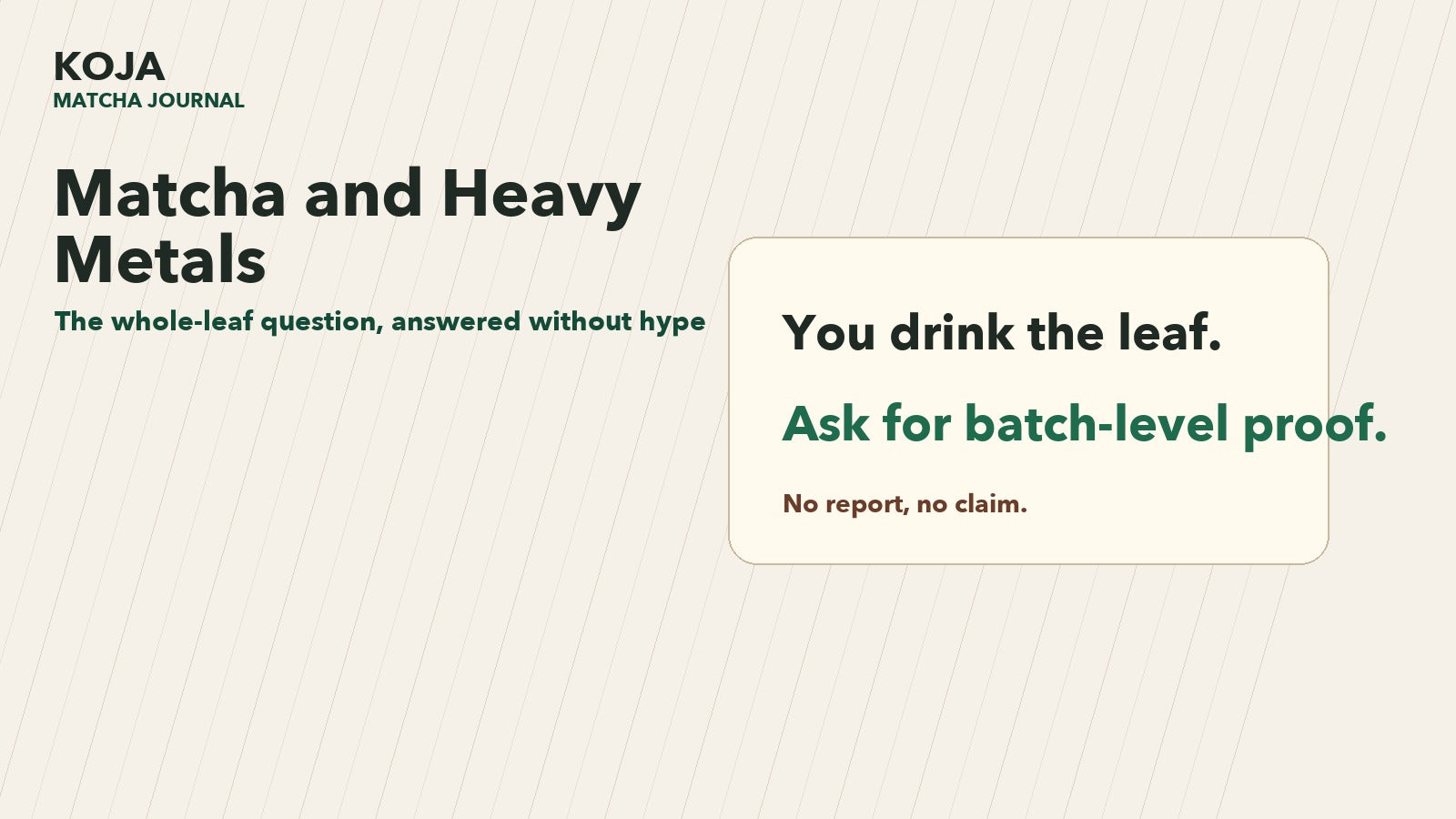
Short answer: Matcha can contain trace heavy metals because it is a plant product and you drink the whole ground leaf. The useful question is not panic. It is proof: region, grade, harvest or lot data and, when a brand claims testing, a report tied to the batch you are buying.
This article replaces our older testing copy because that copy was too broad. The rule is now cleaner: no report, no claim.

Why do people ask about matcha and heavy metals?
People ask because matcha is not steeped and discarded like loose-leaf tea. Matcha is powdered leaf. You whisk it into water and consume the powder itself.
That whole-leaf format is the point of matcha. It gives color, texture and concentration. It also means contaminants cannot be treated as a vague afterthought. You cannot judge them by taste, foam or a ceremonial label.
Does ceremonial grade prove matcha is cleaner?
No. Ceremonial grade does not prove a heavy-metal result. It is a quality and use-case term, not a safety certificate.
Good ceremonial matcha should use tender spring leaves, careful shading and fine milling. Those facts can improve taste and texture. They still do not replace a batch report. If a brand uses the word ceremonial as proof of purity, ask for the actual evidence.
What can a label tell you?
A label can tell you useful sourcing context: region, grade, format, dose and sometimes harvest or lot. That context is valuable, but it is not the same as a contaminant result.
- Region: a named Japanese region is more useful than generic origin text.
- Grade: it explains intended use, not a lab result.
- Dose: 2 g per bowl keeps exposure and cost math visible.
- Lot or batch: it lets a report match a specific product instead of a generic page.
What should you ask a matcha brand?
Ask whether the brand can show a batch-level report for the product you are buying. If the answer is no, treat every lab or purity claim as unproven.
Useful questions:
- Which region and grade is this specific product?
- What is the serving size used in the nutrition and caffeine claims?
- Is there a report for this batch, not just a supplier certificate?
- Does the report name the analytes, date and lab?
What is KOJA's current position?
KOJA's current position is deliberately conservative: we publish and repeat only the data we can substantiate on the live product. Region, grade, format, serving size and price per bowl are fair to state. A lab-test claim is not fair unless the relevant report exists and can be shown.
That may sound less exciting than a purity badge. Good. Transparency should be quieter than marketing. When a report is available, it should be connected to the exact lot. Until then, we do not ask you to take the word on faith.
How should you buy matcha if this matters to you?
Buy fewer, better bowls from brands that answer specific questions. Avoid anonymous powder, impossible serving counts and sweeping purity language without evidence.
A practical buying filter is simple: named region, clear grade, 2 g serving math, realistic price and accountable batch language. Start with all KOJA matcha or read the broader grade breakdown on ceremonial grade matcha.
Use the data you can see
If you want matcha without vague purity theater, start with the facts on the product page: grade, region, format and cost per 2 g bowl. Browse all KOJA matcha and compare the lines before you buy.
FAQ
Can matcha contain heavy metals?
Yes, matcha can contain trace heavy metals like other plant products. The useful question is batch-level proof, not alarmist marketing.
Can you taste heavy metals in matcha?
No. Taste, color and grade do not prove heavy-metal levels. Only a relevant batch report can answer that question.
Does KOJA claim every batch has a lab report?
No. KOJA does not make a lab report claim unless a specific batch report exists and can be shown.
Keep reading: How to Choose Matcha · The Matcha Shortage Explained
Share:
How Much Caffeine Is in Matcha? The 2 g Numbers
How Much Caffeine Is in Matcha? The 2 g Numbers