

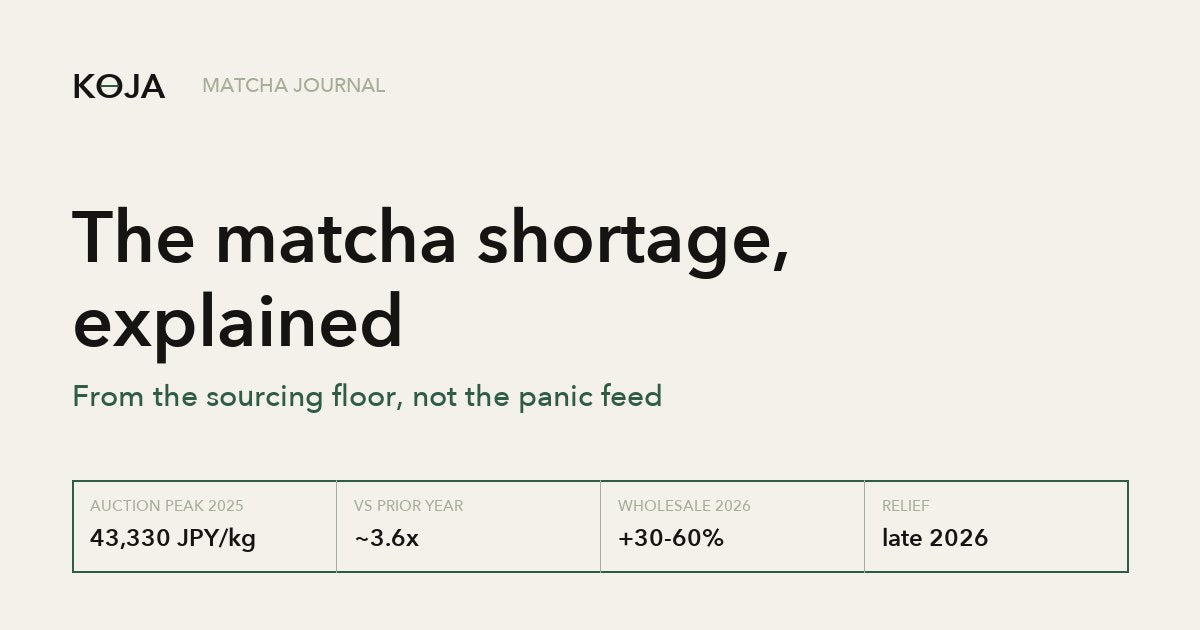
If your favorite matcha doubled in price or simply vanished, you did not imagine it. The matcha shortage is real, it started in 2025 and it is still shaping every tin sold in Europe in 2026. At the auction peak, Uji first-flush tencha cleared at 43,330 yen per kilo, roughly 3.6 times the year before. We buy matcha for a living, so instead of another panic piece, here is the shortage explained from the sourcing floor: what actually happened, what it costs you and how to buy well while it lasts.
What is the matcha shortage in one paragraph?
Global demand for matcha exploded faster than Japan can grow tencha, the shaded leaf that becomes matcha. Tencha cannot be scaled quickly: fields need years, shading needs infrastructure and stone mills grind slowly. When demand hit that wall in 2025, auction prices spiked, heritage Uji houses froze new wholesale accounts and put existing buyers on allocation. Through late 2026, trade reports still put wholesale tencha 30 to 60 percent above pre-2025 levels.
What caused it?
- A demand shock. Matcha went from tea-shop niche to default café order across Europe, North America and the Gulf in about three years. Social feeds did in months what marketing had not done in decades.
- A supply side that moves in years. Converting a tea field to shaded tencha production takes seasons, not quarters. Skilled growers are aging and stone-mill capacity is finite. You cannot print first harvest.
- Concentration at the top. The most famous region, Uji, is also one of the smallest. Prestige demand piled onto the least scalable supply, which is why Uji froze new accounts first. We compared the regions in Kagoshima vs Uji.

The shortage in numbers
| Fact | Status |
|---|---|
| Uji first-flush tencha auction peak 2025 | 43,330 yen per kilo, about 3.6x the prior year |
| Wholesale tencha through late 2026 | 30-60% above pre-2025 levels per trade reports |
| Heritage Uji houses | New wholesale accounts frozen, existing buyers on allocation |
| Allocation contracts | Standard at Uji heritage houses, spreading through the trade per trade reports |
| Relief in sight | Kagoshima tencha expansion expected to ease tightness from late 2026 |
What does the shortage mean for your cup?
Three things, and only one of them is the price tag.
- Prices stay up. Even as supply recovers, nobody in the chain expects pre-2025 price levels back soon. Budget for it or buy smarter formats. Our cost math per bowl is in what a matcha habit actually costs.
- Quality claims got looser. Scarcity attracts opportunists. Powder of unclear origin now ships under confident labels, because "ceremonial" is not a regulated word. The empty tin costs the seller nothing, the claim costs even less.
- Freshness suffers quietly. Some sellers stretch old stock when new lots are allocated. A missing mill date during a shortage is not an oversight, it is a strategy.
How do you buy good matcha during a shortage?
The checklist gets shorter, not longer. Demand facts a seller cannot fake cheaply.
- Harvest stated. First harvest, named on the label.
- Origin named. A region and ideally a garden, not just "Japan".
- Mill date printed. The single best shortage-era signal. Fresh grinding means the seller has actual allocation, not warehouse leftovers.
- Color check. Vivid jade green. Olive or yellowish powder is old or late harvest, shortage or not.
The full framework is in how to choose matcha and on the matcha grades page.
How does KOJA handle the shortage?
We made two structural choices before the squeeze made them fashionable. First, we source directly from Kagoshima and Yame, regions with real expansion capacity, instead of bidding on frozen Uji allocation. Second, we print garden, region, harvest and mill date on every tin, so you never have to take a shortage-era claim on faith. How we work is on our about page.
If you run a café and your current supplier just put you on allocation, that is exactly the situation our B2B program exists for: consistent latte-grade supply with batch documentation your guests can read.
Will the matcha shortage end?
The tightness should ease. Kagoshima and other regions are expanding tencha production and trade reports expect meaningful relief from late 2026 onward. What likely will not return is the old price floor. Fields, labor and shading got permanently more expensive, and global demand did not go anywhere. Plan for better availability, not for cheaper matcha.
Want the shortage-proof setup?
Buy sealed stock of a matcha you trust instead of panic-buying whatever is left on shelves. The Daily 90-day box is 89 € for 90 sealed bowls at 0.99 € per bowl, six 30 g bags that stay fresh because you only open one at a time. One decision, one quarter, no shelf roulette.
FAQ
Why is matcha so expensive right now?
Demand outgrew Japan's tencha supply in 2025. Auction prices peaked at about 3.6 times prior-year levels and wholesale remains 30 to 60 percent above pre-2025 through late 2026, which flows into every tin sold in Europe.
Is the matcha shortage over in 2026?
Not yet. Allocation contracts are still standard and prices remain elevated. Kagoshima's tencha expansion is expected to ease the tightness from late 2026, but pre-2025 prices are unlikely to return.
How do I avoid bad matcha during the shortage?
Demand a stated first harvest, a named region, a printed mill date and vivid jade color. Scarcity attracts loose labels, and the mill date is the hardest signal to fake.
Should I stock up on matcha?
Sealed, yes. Matcha degrades after opening, so buy formats with individually sealed portions rather than one large opened tin. That protects freshness without gambling on future prices.
Share:
Iced Matcha Latte Recipe: 3 Minutes, No Shaker
The Best Matcha for Lattes: What Survives Milk