

2 products

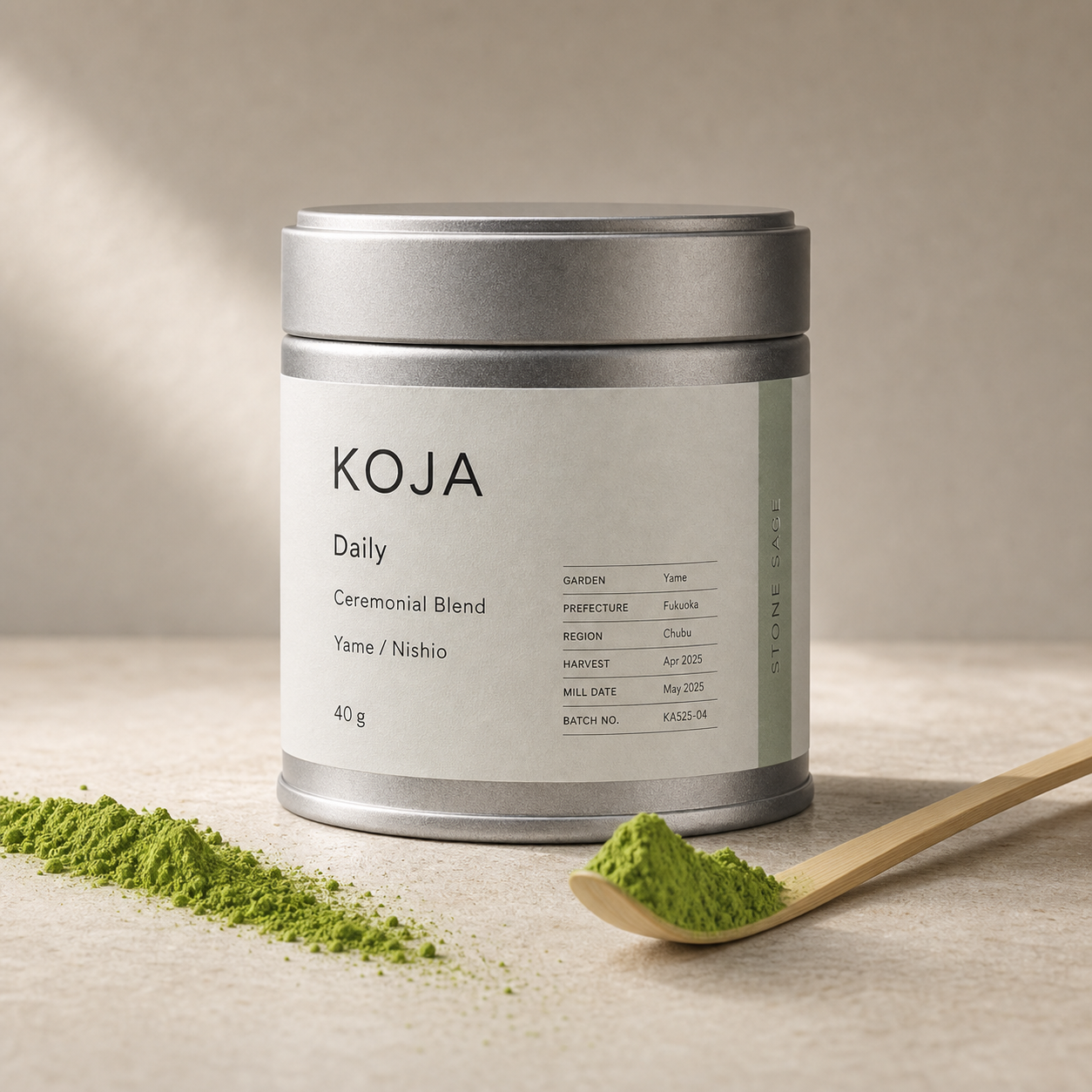
Tins
A matcha tin is not packaging, it is the first piece of equipment you own. KOJA sells two matchas in tins: Origin Nº 1, a single estate ceremonial from Kagoshima (30 g, 39 €) and KOJA Daily, a ceremonial blend from Yame and Nishio (40 g, 29 €). Both tins exist for one reason: milled matcha starts losing aroma the day it leaves the mill and the tin's job is to slow that down.
Why does matcha degrade faster than other tea?
Matcha degrades faster than leaf tea because it is a powder: stone-milling multiplies the surface area exposed to the environment, so everything that ages tea ages matcha quicker. Four forces do the damage. Light bleaches chlorophyll, which is why neglected matcha drifts from vivid green toward dull olive. Oxygen flattens the aroma compounds that make a fresh bowl smell sweet and grassy. Humidity makes the powder clump and mutes the taste before you ever see mold or spoilage. Heat accelerates all three at once.
A clear glass jar on a sunny shelf fails on every count. A half-open bag fails on at least two. This is not a detail you can outsource to good intentions, it has to be solved by the container itself.
What does the tin actually do?
The tin solves the storage problem mechanically instead of asking you to think about it. It is opaque metal, so light exposure is zero from the moment the lid is on. The lid closes with a tight aroma seal, so the powder is not sitting in a slow stream of fresh oxygen between bowls. And because it reseals in one motion, the time the matcha spends open on the counter is exactly as long as it takes to scoop. Keep it away from the kettle and the stove and the heat problem is handled too.
The tin also carries the part of KOJA you cannot taste at first sight: the printed batch data sheet. Garden, region, harvest and mill date are on every tin and every batch is lab-tested. You can check your batch on the verify page. The tin is not just the freshness layer, it is the data carrier.
Why 30 g and 40 g tins instead of a 100 g jar?
Because freshness is a window, not a switch. Once a tin is opened, the matcha is at its best for a number of weeks, even with perfect storage. So the honest move is to size the tin so a normal drinker finishes it inside that window, not to sell the biggest jar that fits on a shelf.
The numbers: Origin Nº 1 comes in a 30 g tin, which is 15 bowls at the standard 2 g dose. KOJA Daily comes in a 40 g tin, 20 bowls. If you whisk three or four bowls a week, either tin is empty within about a month of opening, which means every bowl tastes like the mill date says it should. A 100 g jar at that pace takes a whole season and the last third never tastes like the first. We would rather sell you a size you finish fresh than a size that looks generous.
Which tin is right for you?
Origin Nº 1 is the tin for drinking matcha straight. Single estate, Kagoshima, milled in small batches: it has a defined character that rewards attention, which is the whole point of a usucha you whisk with water and nothing else. At 39 € for 15 bowls it works out to 2.60 € per bowl, espresso-bar territory for a single estate ceremonial. If that grade language is new to you, the ceremonial matcha collection shows where it sits in the lineup.
KOJA Daily is the tin for routine. It is a ceremonial blend from Yame and Nishio, built to taste consistent bowl after bowl and to hold its own when you add milk. At 29 € for 20 bowls it lands at 1.45 € per bowl. The simple rule: Daily for the bowls you drink while doing something else, Origin Nº 1 for the bowls you pay attention to. Plenty of people keep both tins on the counter and let the morning decide.
Tin once, refill forever
The tin is a one-time purchase, not a recurring cost. Once you own it, you switch to 100 g refill pouches of the same matcha and the per-bowl price drops: Origin Nº 1 goes from 2.60 € to 1.78 € per bowl, KOJA Daily from 1.45 € to 1.30 €. You keep the resealable, light-proof container, you stop paying for it and the pouch ships flat. That is the whole system: buy the tin that protects the matcha, then feed it refills for as long as you drink.
FAQ
How should I store a matcha tin at home?
Closed, cool and away from light and steam: a cupboard shelf away from the stove is ideal. The tin handles light and air by itself, so your only jobs are heat and humidity. Refrigeration is unnecessary for a tin you are actively drinking and condensation on cold metal can do more harm than good.
How long does an opened tin stay at its best?
Plan to finish a tin within a few weeks of opening, which is exactly what the 30 g and 40 g formats are sized for. The matcha does not become unsafe after that, it just slowly loses the aroma you paid for. Sealed and stored well, an unopened tin keeps considerably longer, with the mill date on the data sheet as your reference point.
What is printed on the batch data sheet?
Four fields: garden, region, harvest and mill date, plus the fact that the batch was lab-tested. It is on every tin so you never have to take "fresh" on faith. Enter your batch on the verify page to see the record behind your exact tin.