

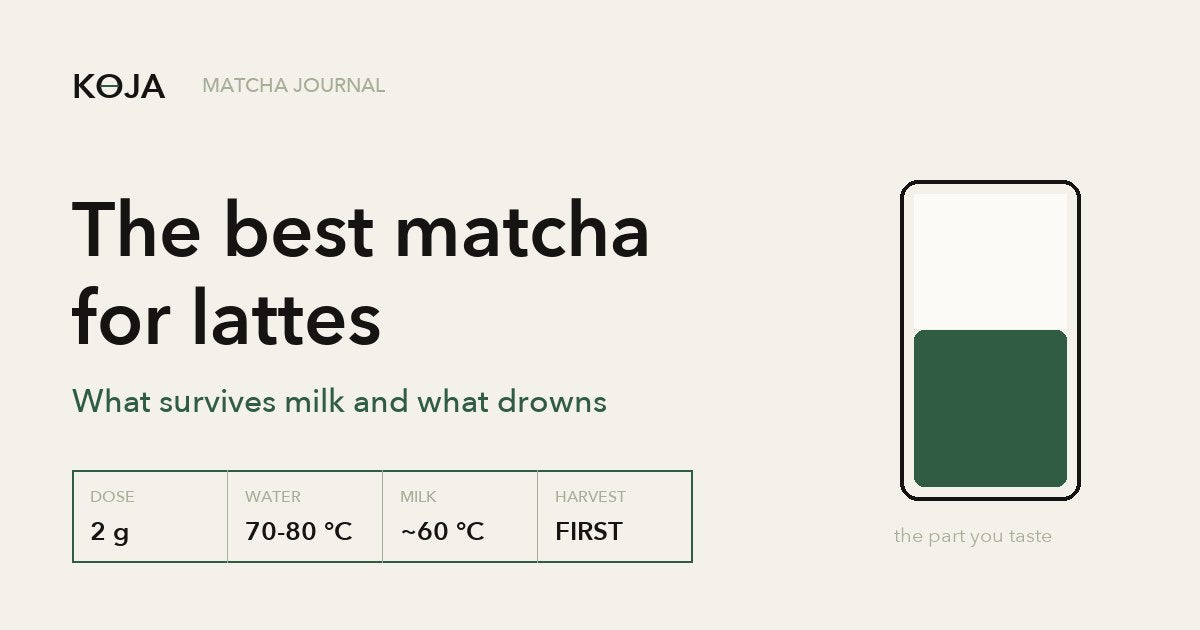
Half the internet says you should never waste ceremonial matcha on a latte. The other half says culinary grade is the reason your latte tastes like cut grass. Both camps are answering the wrong question. The best matcha for lattes is not defined by the grade word on the tin. It is defined by what is still in the cup after you pour 200 ml of milk over 2 g of powder. Milk erases some things, protects others and hides nothing that was truly wrong. Here is what survives, what drowns and how we would spend your money if it were ours.
What is the quick answer on the best matcha for lattes?
A latte needs first-harvest matcha with enough body and umami to stay present under milk. Fine stone grind, vivid green color and a recent mill date matter more than whether the label says ceremonial or culinary. Delicate top-shelf single origins are wasted in milk. Bargain baking powder stays harsh in milk. The sweet spot is a first-harvest blend built for intensity.
That is exactly the job of our Matcha for Lattes collection: the KOJA Matcha-Blend für Latte is blended for milk first, and KOJA Daily covers you if you switch between straight bowls and lattes during the week.
What does milk actually do to matcha?
Milk is not a neutral carrier. Three things happen in the cup.
- Proteins mute the quiet notes. Milk proteins bind a share of the compounds that carry astringency, and they take some of the delicate aroma with them. The florals and the fine sweetness you paid for in a top single origin are the first casualties.
- Fat rounds everything off. Body and umami survive because they are texture and depth, not surface aroma. This is why a latte matcha needs weight, not subtlety.
- Nothing hides real harshness. Milk softens bitterness but does not remove it. Old, dull or late-harvest powder tastes like grass with milk instead of grass with water. We covered the mechanics in why matcha tastes bitter.
So the test is simple. Umami and body survive milk. Delicate nuance drowns. Harshness survives too, just quieter. Buy accordingly.

Do you need ceremonial grade matcha for lattes?
No, and the honest reason is uncomfortable for half the industry: no regulator defines what ceremonial grade means. Any importer can print it on any tin. We wrote up the full picture in what ceremonial grade actually means and on our matcha grades page.
What the label word hides is a real spectrum. At the top sit first-harvest single origins ground for drinking with water only. Their nuance is precisely what milk erases, so using them for a daily latte is paying for detail you will not taste. At the bottom sits baking-grade culinary powder made from later harvests. Its catechin load reads as bitterness that milk only partly covers. A good latte matcha sits between the two: first-harvest leaves, fine grind, blended for presence rather than subtlety.
Which label facts predict a good matcha latte?
Five checks, all readable before you buy.
- Harvest. First harvest (spring) is non-negotiable. Later harvests carry more bitterness into the milk.
- Origin. A named region such as Kagoshima, Yame or Nishio. "Product of Japan" alone tells you nothing about the field.
- Color. Vivid jade green. Olive or yellow-green powder is old, late-harvest or badly stored, and milk will not rescue it.
- Grind. Stone-ground and silk-fine. Gritty powder never fully suspends and sinks to the bottom of the glass.
- Freshness. A mill date or batch data on the tin. This is why we print garden, region, harvest and mill date on every KOJA tin. A label that hides all of this is a label betting you will not ask.
Cheap culinary vs top single origin vs latte blend
| Bargain culinary | Top single origin | Latte-grade blend | |
|---|---|---|---|
| Built for | Baking and smoothies | Straight bowls with water | Milk drinks |
| Under 200 ml milk | Harsh edge stays | Smooth but the nuance is gone | Present, creamy, holds its color |
| Straight with water | Hard to drink | Where it belongs | Solid, less layered |
| Cost logic | Cheap per gram, wasted cup | Premium per gram, wasted nuance | Mid price, nothing wasted |
| Verdict for lattes | Skip | Save it for water | This is the job it was built for |
How do you make a matcha latte that holds up?
The powder is half the result. The method is the other half, and it takes three minutes.
- Sift 2 g of matcha into a bowl. Clumps read as bitterness later.
- Add 30 to 40 ml of water at 70-80 °C and whisk into a smooth, foamy shot. Boiling water scorches even good matcha.
- Heat your milk to about 60 °C and stop well before it boils. Scalded milk flattens the cup.
- Pour the milk over the shot. For iced, pour the same shot over cold milk and ice.
Oat and whole milk carry matcha best. Skim milk thins the texture and lets bitterness poke through. The full walkthrough with tools is on how to make matcha. A chasen works, an electric frother is faster on weekday mornings.
Which KOJA matcha fits which latte habit?
| Your habit | Pick | Why |
|---|---|---|
| A latte every day | Matcha-Blend für Latte, 250 g | Built for milk, 34 € for about 125 lattes at 2 g |
| Lattes plus some straight bowls | KOJA Daily, 30 g tin | One blend that works both ways, 29 € |
| A routine you never want to re-order | Daily 90-day box | 89 € for 90 sealed bowls, 0.99 € per bowl |
| Weekend bowls with water only | Kagoshima Ceremonial, 30 g tin | 39 €, and keep it away from milk |
Want the honest test?
Make the same latte seven mornings in a row and change only the powder. Same milk, same dose, same temperature. If the matcha disappears under your usual oat milk, it was never a latte matcha, whatever the tin claims. Start with the Matcha for Lattes collection, or go straight to the Daily 90-day box if routine is the point and re-ordering is the enemy.
FAQ
How much matcha do you need per latte?
2 g is the baseline, 3 g if you like it strong. At 2 g a 250 g bag makes about 125 lattes, which is roughly four months of daily cups.
Is culinary grade matcha good enough for lattes?
Good latte-grade culinary matcha, yes. Bargain baking culinary, no. The grade word is not regulated, so judge harvest, color, grind and mill date instead of the label.
Why does my matcha latte still taste bitter with milk?
Milk softens bitterness but does not remove it. The usual causes are boiling water, unsifted clumps, too much powder or old late-harvest matcha. Fix the method first, then judge the powder.
What milk works best for matcha lattes?
Oat and whole milk carry matcha best because fat and body support the umami. Skim milk thins the cup and lets the harsh notes through.
Share:
Iced Matcha Latte Recipe: 3 Minutes, No Shaker
Kagoshima vs Uji: An Honest Comparison of Japan's Matcha Regions