

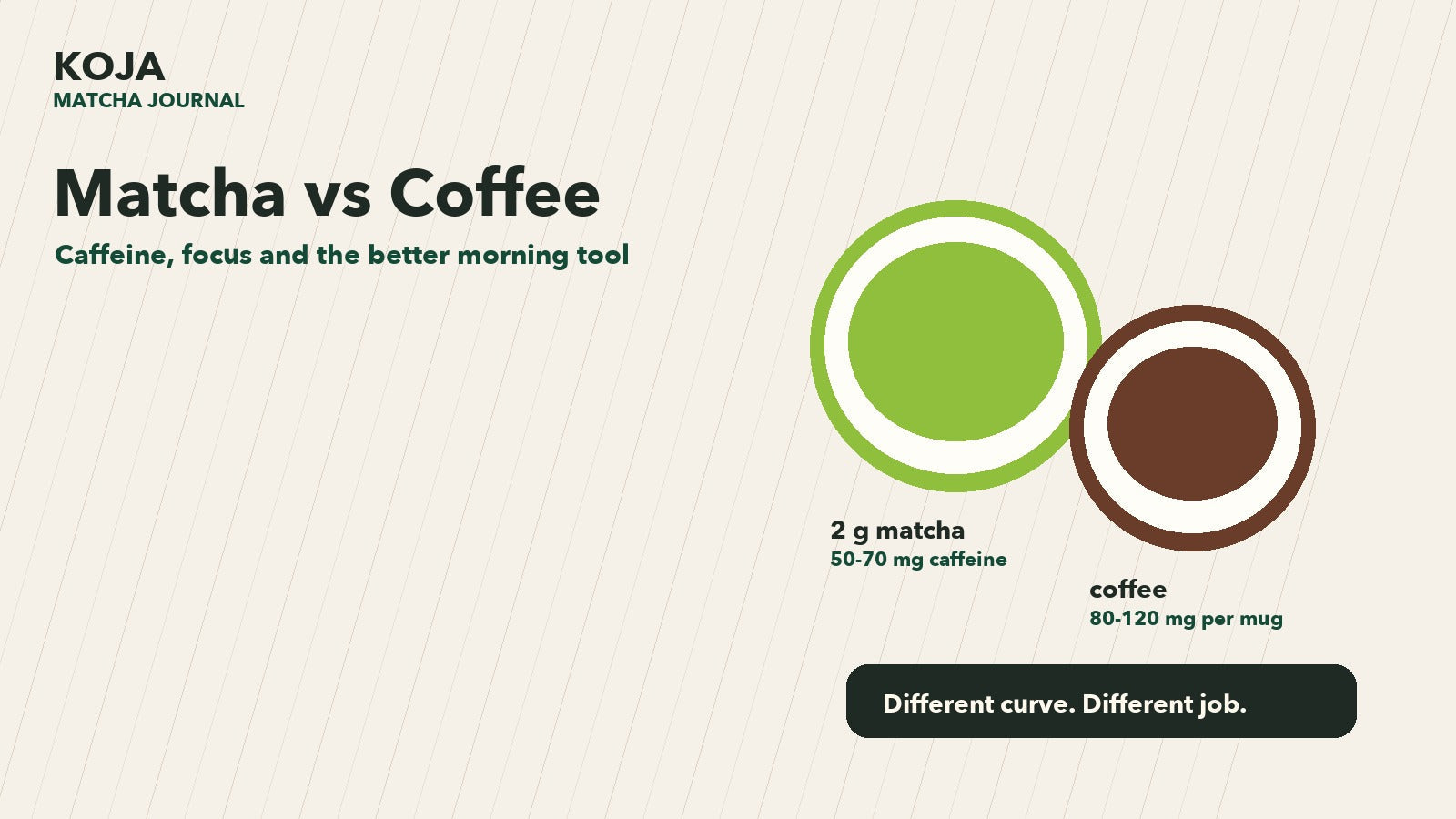
Short answer: In matcha vs coffee, coffee wins when you want a fast, familiar caffeine hit. Matcha wins when you want a measured 2 g serving with caffeine plus L-theanine for calm focus. A standard coffee often carries 80-120 mg caffeine, espresso roughly 60-75 mg and a proper 2 g matcha bowl about 50-70 mg. The better morning cup depends on the job.
Last updated: 1 July 2026. We are using serving-size ranges because caffeine changes with coffee dose, brew method, matcha cultivar, harvest and powder dose. That is the honest way to compare the two.

What is the quick answer on matcha vs coffee?
The quick answer is this: coffee is the sharper tool, matcha is the steadier tool. Coffee gives a faster lift and usually more caffeine per mug. Matcha gives a smaller, measured caffeine dose with L-theanine and a greener taste profile.
| Question | Best fit | Why |
|---|---|---|
| Fastest caffeine hit | Coffee | Higher dose and quick extraction |
| Steady focus | Matcha | Caffeine plus L-theanine |
| Most dose control | Matcha | 2 g powder is easy to repeat |
| Roasted flavor | Coffee | Bean, roast and brew method define the cup |
| Green, creamy or umami flavor | Matcha | Whole shade-grown leaf in the bowl |
If you want a simple rule: choose coffee for a sprint, choose matcha for a work block. Neither drink is morally better. They are different inputs.
How much caffeine is in matcha compared with coffee?
A standard 2 g matcha bowl usually sits around 50-70 mg caffeine, espresso often sits around 60-75 mg and a 240 ml brewed coffee often lands around 80-120 mg. Serving size matters more than the drink category.
This is where matcha marketing gets slippery. A 30 g tin should make 15 serious 2 g bowls. If a brand sells 30 g as 30-45 servings, the serving is a light dusting. That lowers the caffeine number on paper but not because the matcha is special. It is just less powder.
KOJA uses 2 g as the honest bowl baseline. The same serving math also makes cost transparent: 30 g equals 15 bowls, 100 g equals 50 bowls and a 180 g 90-day box equals 90 bowls.
For the narrower numbers page, read How much caffeine is in matcha?.
Why does matcha feel different from coffee?
Matcha feels different because its caffeine comes with L-theanine, an amino acid naturally present in shade-grown green tea. Many drinkers describe that pairing as calm focus rather than a hard spike.
That is not a medical promise and it is not magic. Sleep, food, stress and tolerance still matter. The clean claim is smaller: matcha gives caffeine in a different context. Coffee is roasted-bean extraction. Matcha is whole leaf powder suspended in water.
That whole-leaf format also makes quality obvious. Dull powder, weak dose or water straight off the boil will not compete with a good coffee. A saturated green 2 g bowl made at 70-80 C has a fair chance.
Is matcha better than coffee for focus?
Matcha is often better for steady focus, while coffee is often better for immediate alertness. The reason is not that matcha has no caffeine. It has real caffeine, just usually a lower and more measured serving.
For deep work, that repeatability is useful. Weigh 2 g, add 60-70 ml water and whisk. Tomorrow you can make the same cup again. Coffee can be just as precise if you weigh beans, control grind and control water. Most people do not. They drink whatever the machine made.
If your morning is meetings, a commute or a hard wake-up, coffee may still be the better tool. If your morning is writing, analysis or long concentration, matcha deserves the test.
Which tastes better if you are coming from coffee?
Coffee tastes better if you want roasted bitterness, chocolate notes, acidity and heat. Matcha tastes better if you want green sweetness, umami, creaminess and a lighter finish. A coffee drinker should usually start with a matcha latte before judging straight matcha.
A straight bowl is honest but demanding. It exposes powder quality, water temperature and technique immediately. A latte gives you a softer bridge, especially with oat milk. That does not mean you need the most delicate ceremonial powder under milk. In milk, body matters more than tiny origin notes.
For straight bowls, use ceremonial matcha. For milk drinks, use matcha for lattes or KOJA Daily.
What does matcha cost compared with coffee?
At home, matcha can cost far less than a cafe drink. A daily cafe matcha at 5.50 EUR is about 2,007 EUR per year. KOJA Daily in the 90-day box is 89 EUR for 90 bowls, which is 0.99 EUR per 2 g bowl.
The comparison is not cafe bad, home good. A cafe sells space, staff, milk, training and a finished drink. That has value. The question is whether you need to buy the room every morning or whether you only need the cup.
For the full calculation, see the matcha habit cost math.
How should you switch from coffee to matcha without hating it?
Do not quit coffee on day one. Replace the second coffee first, use a proper 2 g matcha dose and keep the method stable for seven days. That gives you a real comparison instead of a novelty test.

- Days 1-2: keep your first coffee, replace the second cup with a matcha latte.
- Days 3-4: use 2 g matcha before lunch and avoid changing every variable at once.
- Days 5-6: try one straight bowl with ceremonial matcha.
- Day 7: decide by taste, focus and whether the habit feels repeatable.
The method matters. Use 2 g powder, 60-70 ml water at 70-80 C and 15-20 seconds of whisking. The full method is here: how to make matcha.
What should a serious matcha label show?
A serious matcha label should show serving size, region, grade, format and enough batch context to make the product accountable. Words like pure, premium and ceremonial are weaker than numbers.
- Serving size: 2 g for a real bowl.
- Region: Kagoshima, Uji, Yame or a clearly stated blend.
- Grade: ceremonial for straight bowls, premium or daily blend for routine use, latte-grade for milk.
- Format: 30 g tin, 100 g refill or 180 g box.
- Cost per bowl: do the math before the adjective does it for you.
KOJA's position is simple: transparency first, focus benefit second, aesthetics third. If the data is thin, the label should be quieter.
Which KOJA matcha fits which coffee habit?
The right KOJA matcha depends on how you drink coffee today. Straight-cup people should start ceremonial. Latte people should start Daily or Latte. Budget-and-routine people should look at the 90-day boxes.
| Your current habit | KOJA route | Why |
|---|---|---|
| Black coffee or espresso | Ceremonial matcha | Best chance of liking the straight bowl |
| Flat white or iced latte | Matcha for lattes | Enough body for milk |
| Daily office coffee | Daily matcha | Built for repetition, not rare tasting notes |
| Subscription coffee beans | 90-day boxes | 90 x 2 g bowls with clear cost per bowl |
| Not sure which matcha yet | Sample set | 5 x 10 g samples to find your bowl first |
Want the honest test?
Run seven mornings with one measured 2 g bowl. If you are not sure which matcha fits, start with the KOJA sample set: 5 sorts as 10 g samples. If you already know your bowl, choose the 90-day box that matches how you drink: Daily for routine, ceremonial for straight bowls.
FAQ
Is matcha stronger than coffee?
Usually no per cup. A 240 ml coffee often carries more caffeine than a 2 g matcha bowl. Matcha can still feel steadier because it combines caffeine with L-theanine.
Can matcha replace morning coffee?
Yes, if the dose and taste work for you. Start with one 2 g bowl for seven mornings and compare focus, repeatability and whether you still reach for another cup.
Which KOJA matcha should coffee drinkers start with?
For milk drinks, start with KOJA Daily or Matcha for Latte. For straight bowls, start with ceremonial matcha from Kagoshima or the ceremonial collection.
Share:
What 'Ceremonial Grade' Matcha Actually Means
The Best Matcha for Lattes: What Survives Milk